


Las Vegas homeowners face a tough choice when it comes to their lawns. The desert climate makes keeping grass green a real challenge. You need to think about water costs, time spent on care, and how your yard will look year-round.
Artificial turf typically costs more upfront but saves money over time through eliminated water bills, no mowing expenses, and minimal maintenance needs, while real grass requires ongoing costs for irrigation, fertilization, mowing, and pest control that add up quickly in Las Vegas’s harsh climate. The gap between these two options becomes clear when you look at what you’ll spend over several years. Water alone can make a big difference in your monthly bills.
This guide breaks down the real numbers behind both choices. You’ll learn what to expect for installation, monthly upkeep, and long-term value. We’ll also cover how each option holds up in Las Vegas’s extreme heat and what that means for your wallet.
Understanding the Las Vegas Climate for Lawns
Las Vegas sits in the Mojave Desert, where summer temperatures regularly exceed 100°F and the area receives less than 5 inches of rain per year. These extreme conditions directly affect your ability to maintain any type of lawn and determine how much water and money you’ll spend on landscaping.
Impacts of Arid Conditions on Lawn Choices
The desert climate in Las Vegas creates unique problems for natural grass. Your lawn faces scorching temperatures from May through September, with daytime highs often reaching 105-115°F. Real grass needs constant watering to survive these conditions.
Natural grass requires about 1-1.5 inches of water per week during hot months. In Las Vegas, this means watering your lawn almost daily. The dry air pulls moisture from the soil quickly, and the intense sun burns grass blades that don’t get enough hydration.
Your grass also struggles with the limited rainfall. The small amount of rain that falls mostly comes during winter months when grass grows less. You can’t rely on natural precipitation to keep your lawn alive at any point in the year.
The soil composition adds another challenge. Las Vegas has alkaline soil with high mineral content. This type of soil makes it harder for grass roots to absorb nutrients and water efficiently.
Challenges for Water Usage and Conservation
Water conservation matters in Las Vegas more than in most cities. The area depends heavily on Lake Mead for its water supply, which has dropped to record low levels in recent years. Your lawn’s water needs directly compete with the region’s limited water resources.
A 1,000 square foot natural grass lawn uses approximately 7,000-10,000 gallons of water monthly during summer. At current Las Vegas water rates, this adds $30-40 to your monthly bill just for lawn irrigation. Annual water costs for grass easily reach $360 or more.
The Southern Nevada Water Authority offers rebates to homeowners who remove grass, recognizing that traditional lawns use too much water. You can receive money back for converting to water-smart landscaping options.
Your water usage also affects the broader community. Outdoor watering accounts for about 60% of residential water use in Las Vegas. Reducing lawn water consumption helps the entire region save water and preserve resources for essential needs.
Initial Installation Costs: Artificial Turf vs. Real Grass
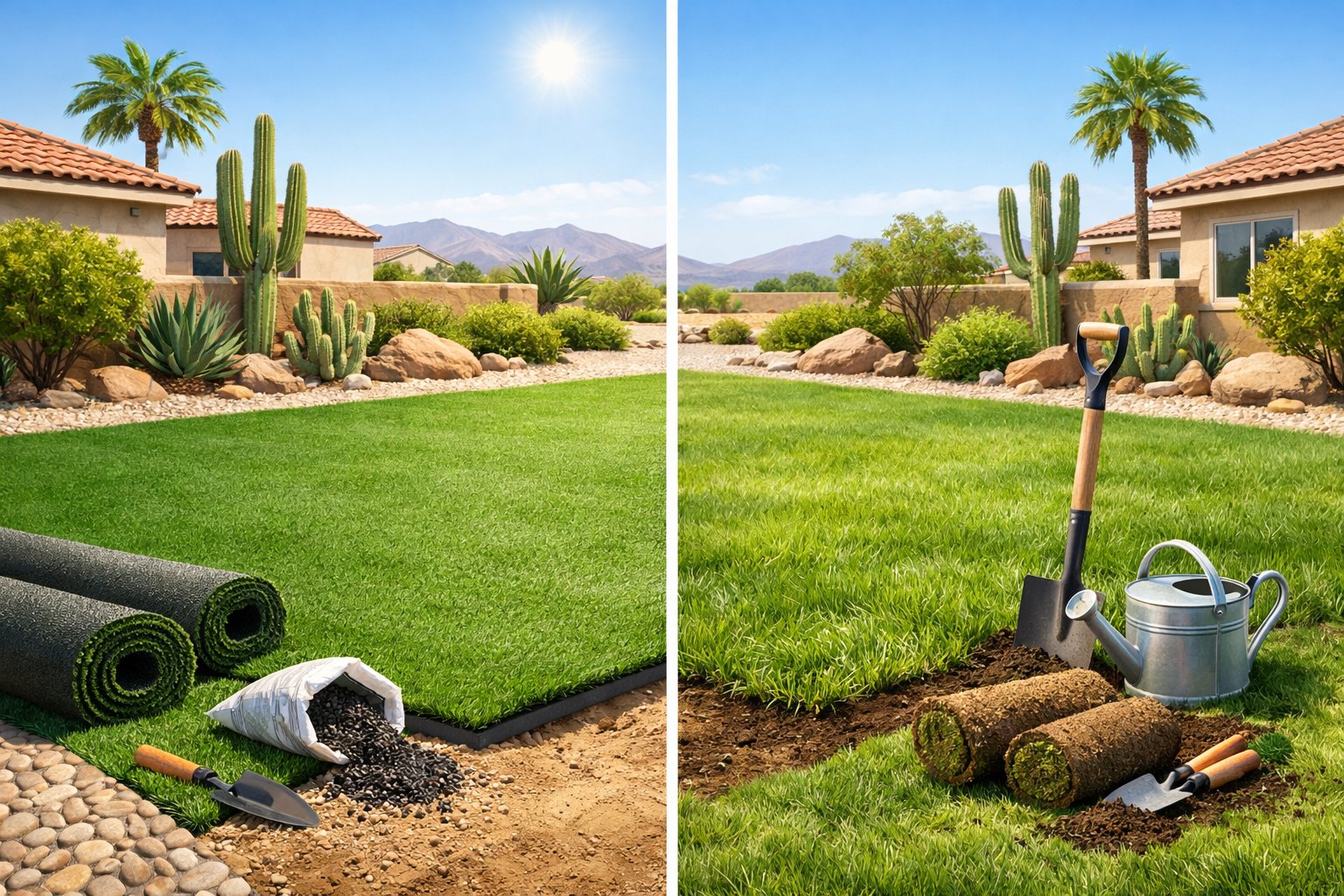
Artificial grass installation typically costs $4.50 to $9.00 per square foot in Las Vegas, while real grass installation ranges from $1.50 to $4.50 per square foot. The price difference comes from materials, labor complexity, and preparation requirements that vary between synthetic and natural lawns.
Cost of Artificial Grass and Turf Installation
The cost of artificial grass depends on turf quality, backing material, and infill material choices. Basic synthetic grass with 8-10 mm blade height starts at $2.50 per square foot for materials alone. Mid-range options cost $5.00 to $8.50 per square foot, while premium products exceed $9.50 per square foot.
Installation adds $3.00 to $9.00 per square foot to your total. A 500 square foot artificial lawn costs between $3,750 and $9,250 installed. For a 1,000 square foot synthetic lawn, expect to pay $9,500 to $17,000.
Your artificial turf installation includes removal of existing grass, base preparation with crushed rock, weed barrier installation, and seaming work. Equipment costs like compactors and rollers add $0.50 to $2.50 per square foot. You may pay $100 to $300 for permits if drainage modifications are needed.
Real Grass Lawn Seeding and Sod Expenses
Real grass offers two installation methods with different price points. Grass seed costs $0.30 to $0.90 per square foot for materials and labor, making it the cheapest option. Sod installation ranges from $1.50 to $4.00 per square foot installed.
A 500 square foot natural lawn costs $750 to $2,000 with sod or $150 to $450 with seed. For 1,000 square feet, sod runs $1,500 to $4,000 while seeding costs $300 to $900. These prices include topsoil, fertilizer, and basic grading.
Your real grass installation requires soil testing, amendment, and starter fertilizer. Irrigation system setup adds $1.50 to $3.50 per square foot if you need new sprinklers. Delivery fees for sod or topsoil typically cost $75 to $200.
Labor and Site Preparation Differences
Installing artificial grass takes 1 to 3 days and requires excavation 3 to 4 inches deep. Workers remove existing vegetation, compact the base, and install drainage layers before laying turf. Labor rates in Las Vegas average $50 to $90 per hour for skilled crews.
Real grass installation takes 2 to 5 days for sod or seed establishment. Site preparation involves tilling, grading, and soil amendment to create proper drainage. You need less excavation depth compared to synthetic lawn installation.
| Preparation Type | Artificial Turf | Real Grass |
|---|---|---|
| Excavation depth | 3-4 inches | 1-2 inches |
| Base material | Crushed rock, weed barrier | Topsoil, amendments |
| Installation time | 1-3 days | 2-5 days |
| Equipment needs | Compactor, roller, seaming tools | Tiller, spreader, roller |
The complexity of turf installation raises labor costs but eliminates future replanting expenses. Real grass needs immediate watering schedules and protection during establishment, adding to early maintenance demands.
Ongoing Maintenance and Care Requirements
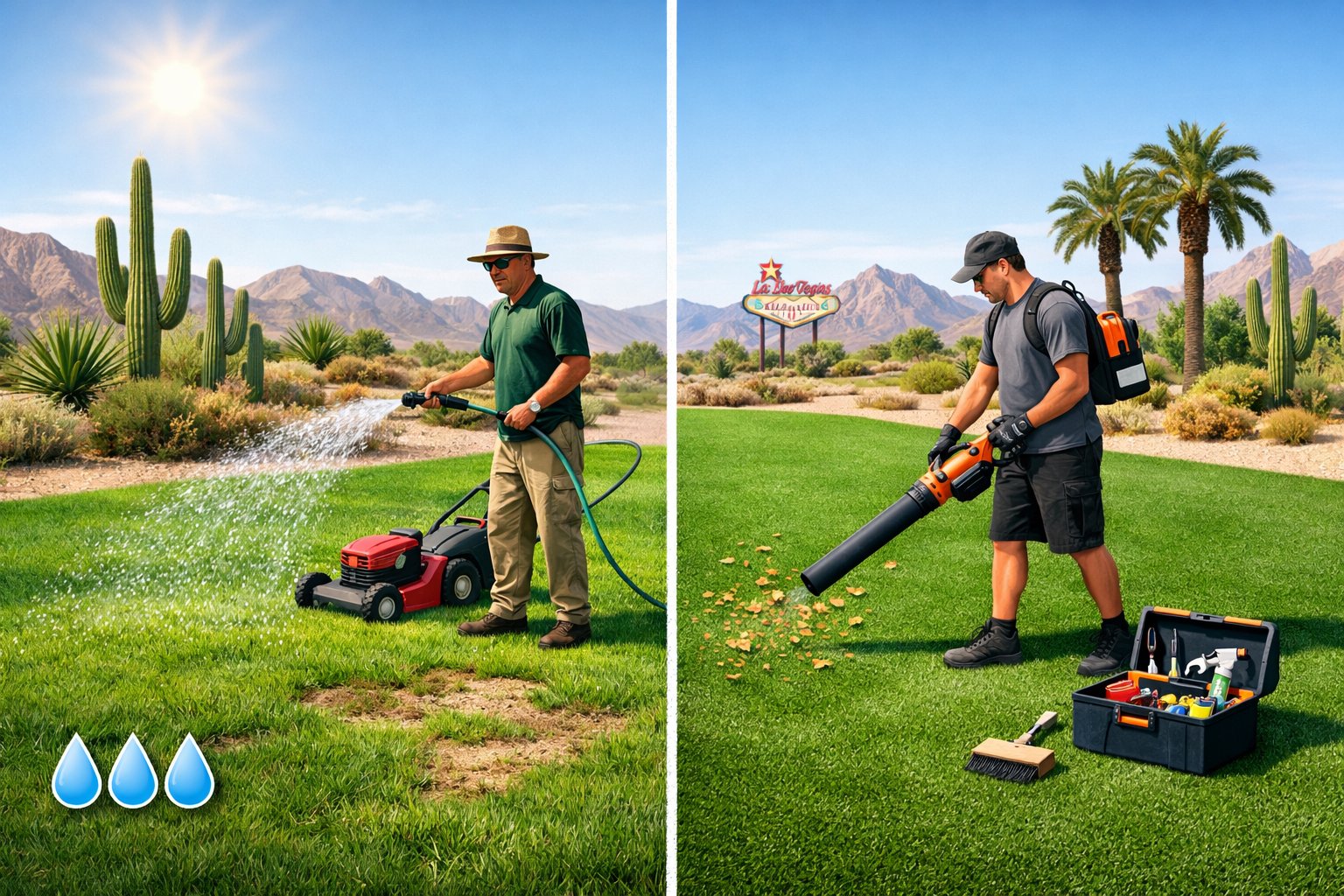
Natural grass lawns in Las Vegas demand regular attention with weekly mowing, seasonal fertilizers, and constant watering, while artificial turf needs occasional cleaning and annual professional grooming to maintain its appearance.
Lawn Maintenance for Natural Grass
Your real grass lawn requires consistent care throughout the year to stay healthy. You need to mow and edge your lawn weekly during growing seasons, which costs around $1,020 annually for 1,000 square feet.
Regular maintenance tasks include:
- Watering: Your lawn needs frequent irrigation in Las Vegas’s desert climate, costing about $360 per year
- Fertilizers: You must apply treatments multiple times yearly at $207 annually
- Weed control: Pre-emergent treatments cost $150 per year to prevent unwanted growth
- Pest management: Chemical pesticides and herbicides add $99 to your annual expenses
- Aeration: Your soil needs periodic aeration to improve root growth and water absorption
- Repairs: Sprinkler system fixes average $120 yearly
The total yearly cost for lawn care reaches $1,956 for 1,000 square feet. These expenses continue every year you maintain natural grass.
Artificial Turf Upkeep and Longevity
Your synthetic turf requires minimal maintenance compared to natural grass. You only need to remove debris with a leaf blower or light rake, costing $0-10 annually if you do it yourself.
Professional grooming keeps your artificial turf looking its best. Annual grooming services cost between $1,000-$1,370 for 1,000 square feet. This service includes brushing fibers, removing debris, and checking infill levels.
The durability of quality synthetic turf lasts 15-20 years with proper care. Your artificial turf maintains its appearance year-round without brown patches or bare spots. You don’t need to worry about reseeding dead areas or dealing with weather damage.
Your total annual maintenance costs stay consistent at $1,010-$1,380, which is roughly half what you would spend on a real grass lawn.
Water Usage and Monthly Costs
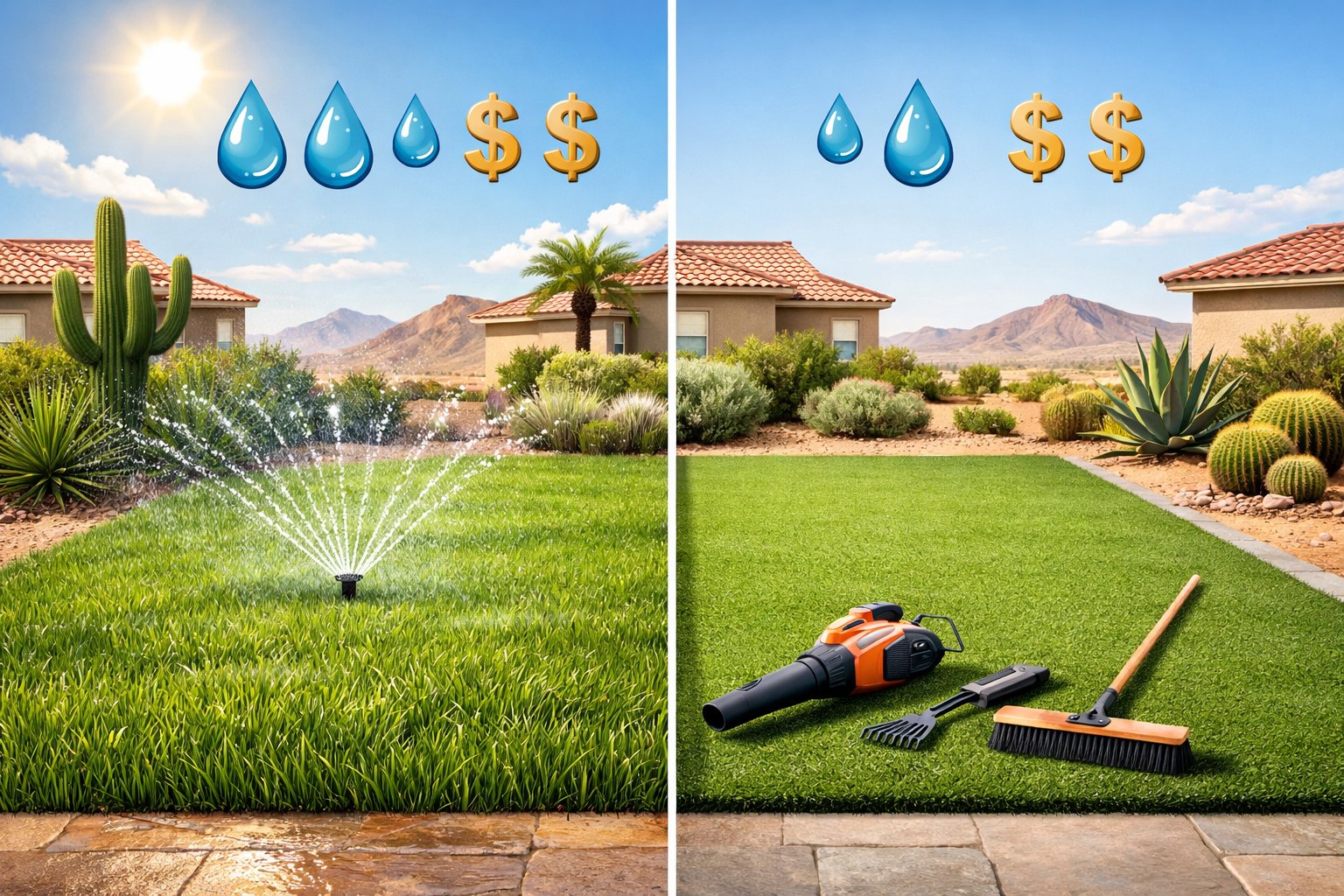
Real grass lawns in Las Vegas require substantial water to stay green, which directly impacts your monthly utility bills. Artificial turf eliminates nearly all water usage, offering measurable savings that accumulate over time.
Water Bills for Real Grass Lawns
Your natural grass lawn needs consistent watering to survive in Las Vegas’s desert climate. Most homeowners use either a sprinkler system or irrigation system to maintain their lawns.
A typical 1,000 square foot grass lawn in Las Vegas requires about 55-60 gallons of water per square foot annually. This translates to roughly 55,000-60,000 gallons per year for that area alone.
Water bills for maintaining real grass can range from $50 to $200 per month during peak summer months. The exact amount depends on your lawn size and local water rates.
Your water usage increases significantly from May through September when temperatures exceed 100 degrees. During these months, you’ll need to run your sprinkler system daily or every other day to prevent brown patches and dead grass.
Savings with Artificial Turf
Artificial turf requires virtually no water beyond occasional rinsing to remove dust or debris. You can save water by eliminating 55,000 gallons or more annually per 1,000 square feet of turf.
The water savings translate to approximately $600 to $2,400 per year for an average residential lawn. These savings begin immediately after installation and continue for the 15-20 year lifespan of quality artificial turf.
You won’t need to maintain or operate an irrigation system, which removes additional costs for system repairs, timer replacements, and valve maintenance. Many Las Vegas homeowners recover their artificial turf installation costs within 5-8 years through water bill reductions alone.
Environmental Impact and Sustainability
Both artificial turf and real grass affect the environment in different ways. Real grass requires chemical treatments that can harm local ecosystems, while synthetic options eliminate these needs but introduce other environmental concerns.
Chemical Usage and Pollution
Real grass lawns need regular applications of fertilizers and pesticides to stay healthy in Las Vegas’s harsh climate. These chemicals often run off into local water systems during irrigation, creating pollution that affects wildlife and groundwater quality. Fertilizers contribute to nutrient pollution in water sources, while pesticides can harm beneficial insects and local animal populations.
Synthetic grass eliminates the need for these chemical treatments entirely. You won’t need to apply any fertilizers or pesticides to maintain your synthetic lawn’s appearance. This means no chemical runoff enters storm drains or seeps into the soil beneath your property.
However, some artificial turf products use crumb rubber infill made from recycled tires. These rubber particles can contain heavy metals and other compounds that may leach into surrounding soil over time. Newer synthetic turf options offer alternative infill materials like silica sand or organic compounds that reduce these concerns.
Carbon Footprint and Resource Conservation
Real grass requires gas-powered mowers, edgers, and blowers for regular maintenance. These tools emit carbon dioxide and other pollutants into the air every time you use them. The production and transportation of fertilizers and pesticides also add to the carbon footprint of natural lawns.
Artificial turf cuts down on emissions by removing the need for lawn equipment. You won’t burn any fuel maintaining your synthetic lawn throughout the year. The manufacturing process for synthetic grass does create emissions, but these one-time costs often balance out over the product’s 15 to 20-year lifespan.
Water conservation stands out as the biggest environmental benefit of artificial turf in Las Vegas. Natural grass needs thousands of gallons of water monthly to survive the desert heat. Synthetic grass requires no irrigation, preserving a critical resource in a region facing ongoing water shortages.
Aesthetic Appeal and Property Value
Your lawn’s appearance directly affects your home’s curb appeal and market value. Both artificial turf and real grass offer different visual benefits that impact how buyers and neighbors view your property.
Curb Appeal Throughout the Year
Artificial turf maintains a consistent green appearance in every season. Your lawn stays vibrant during Las Vegas’s scorching summers when natural grass typically browns and struggles. The best artificial grass products now feature varied blade heights and multiple shades of green that closely mimic real grass texture and color.
Real grass provides an authentic natural look that some buyers prefer. However, maintaining that appeal in Las Vegas requires significant effort. Without constant watering and care, natural lawns develop brown patches and bare spots. During drought restrictions, your real grass lawn may look stressed or patchy for months at a time.
Visual consistency is where fake grass excels. You get the same lush appearance year-round without seasonal die-off or weather damage.
Effect on Property Value
Artificial turf can increase your property value in Las Vegas’s water-scarce market. Buyers appreciate low-maintenance landscapes that reduce utility costs. The immediate savings on water bills and lawn care make homes with quality artificial turf more attractive to potential buyers.
Real grass may appeal to buyers who prefer natural landscaping. Yet the ongoing costs and maintenance requirements often work against property value in desert climates. Appraisers consider the long-term landscape expenses when evaluating homes.
Modern artificial turf installations typically add value when professionally installed with proper drainage and backing. Budget or poorly installed fake grass can have the opposite effect and detract from your home’s appeal.
Long-Term Savings and Return on Investment
Artificial turf costs more upfront but typically saves money over several years through lower maintenance and water bills. Real grass appears cheaper initially but ongoing care expenses add up quickly in Las Vegas’s desert climate.
Comparing Total Cost Over Time
The first five years show the clearest difference between artificial grass cost and real grass expenses. Artificial turf requires an initial investment of $8 to $12 per square foot installed. Real grass costs $0.30 to $4 per square foot to plant.
Real grass demands consistent spending after installation. You’ll pay for weekly mowing, fertilizer every few months, pest control, and significant water usage. These maintenance costs average $2,000 to $3,000 per year for a standard Las Vegas lawn.
Artificial turf needs minimal maintenance. You might spend $100 to $200 annually on occasional cleaning and minor repairs. Water costs drop to zero for irrigation.
Over 10 years, a 1,000 square foot real grass lawn costs roughly $20,000 to $30,000 in total expenses. The same area in synthetic turf costs $10,000 to $12,000 initially plus about $1,500 in maintenance, totaling $11,500 to $13,500.
Estimating Break-Even Points
Most Las Vegas homeowners reach their break-even point within 3 to 5 years after installing artificial turf. The exact timing depends on your lawn size and local water rates.
A 500 square foot lawn typically breaks even in 4 to 5 years. Larger lawns of 1,500 square feet or more often break even faster, around 3 to 4 years, because maintenance savings scale with size.
Water costs heavily influence these calculations. Las Vegas water rates average $1.50 to $2 per 1,000 gallons. Real grass needs 1 to 1.5 inches of water weekly during summer months.
Your break-even point comes sooner if you currently pay for professional lawn services. Professional mowing and fertilization add $150 to $300 monthly to real grass expenses.